


In the world of luxury interiors, the wood surface is not merely an external covering material, but the very “soul” that expresses the product’s class, sophistication, and artistic value. Especially with luxury furniture lines for the living room or bedroom, where aesthetics are always prioritized, the quality of the wood surface finish is the determining factor in the viewer’s first impression.
To achieve a standard of perfection, the process of wood surface treatment and finishing in the high-end interior industry requires a rigorous procedure, meticulous craftsmanship combined with advanced technology. Below are the critical steps in this process.
Selecting and Pre-processing Premium Wood Materials
A quality finished surface can only come from perfect initial wood sourcing. In the luxury interior sector, precious woods such as Gõ Đỏ (Afzelia), Óc Chó (Walnut), Sồi Trắng (White Oak), Ash, or Cẩm Lai (Rosewood) are often chosen due to their fine grain, luxurious color, and high stability.

The wood panels are dried using vacuum drying or computer-controlled steam drying technology to reduce the moisture content to an ideal level (8–12%), preventing future shrinkage and cracking. This pre-processing step sets the foundation for the wood surface to achieve absolute stability before moving on to the subsequent refinement stages.
Precision Shaping and Fabrication
In the high-end interior sector, every detail demands perfect precision. After being cut, planed, routed, turned, carved, and so on, each wood component is controlled for tolerance at a level less than 0.1mm.
Especially for living room furniture products like sofas, coffee tables, decorative cabinets, or bedroom furniture such as beds, nightstands, and dressing tables, the large contact surfaces require near-absolute flatness. This not only provides a foundation for the topcoat to adhere firmly but also helps reflect light better, delivering a high-end aesthetic effect.
Raw Surface Treatment – Grinding, Filling, and Multi-level Sanding
This is a critically important step in creating a silk-smooth wood surface. In luxury interiors, high-end workshops typically apply a process of multi-stage grinding, filling, and sanding, using sandpaper from high grit (P120) to ultra-fine (P800 or P1000).
-
The surface is filled and patched for tiny pinholes using specialized wood glue.
-
Subsequently, it is carefully sanded along the wood grain to avoid damaging the veneer/pattern.
-
After each sanding session, dust is cleaned using clean compressed air and anti-static cloths.

Repeating this stage multiple times helps the wood surface become perfectly smooth and flat, free of microscopic imperfections, making it ready for the coloring and finishing step.
Color Treatment – Staining, Coloring, and Toning
Not just for decoration, the color treatment step also aims to highlight the natural wood grain, creating visual depth for the product.
Artisans often use solvent-based or water-based wood dyes, combined with the technique of hand-wiping multiple thin layers of stain. Each layer of color is allowed to dry and lightly sanded before the next layer is applied.
In the high-end furniture segment, workshops also apply the toning technique (adjusting the overall hue) to ensure that all wood components on the same product have a consistent, luxurious color – this is particularly crucial when crafting coordinated living room or bedroom furniture sets.
Applying the Finishing Coat – Protection & Surface Effect
This step directly determines the visual and tactile experience of the wood product. In luxury interiors, international standards often require:
-
Sealer: Helps seal the surface and increase adhesion for the topcoat.
-
Topcoat: Can be high-gloss, semi-gloss, or silk-matte – applied by spraying in a standard clean room to prevent dust contamination.
- High-grade PU, PE, or NC coating technology is commonly used, sometimes combined with UV coating or eco-friendly water-based paint to enhance color durability, scratch resistance, and chemical resistance.
Between the coating layers, the surface is lightly sanded and thoroughly cleaned again to ensure the finish is mirror-flat, crystal-clear, and reflects light subtly – the element that creates the luxurious appearance of high-end furniture.
Polishing and Final Finishing
After the final coat is applied, the surface is allowed to stabilize for $7 \text{–} 14$ days before being polished using a low-speed machine combined with ultra-fine polishing compounds.
This stage is what creates the signature luxurious light effect of luxury wood furniture – an absolutely flat surface, with a deep gloss and a gentle, water-like light reflection.
Finally, each product is rigorously inspected under color-standard lighting to ensure no minor defects exist, before being packaged and delivered to the customer.
Conclusion
The process of wood surface treatment and finishing in the high-end interior industry requires not only exquisite craftsmanship but also a seamless combination with modern technology, aiming to deliver wood creations with superior aesthetic value, durability, and artistic merit.
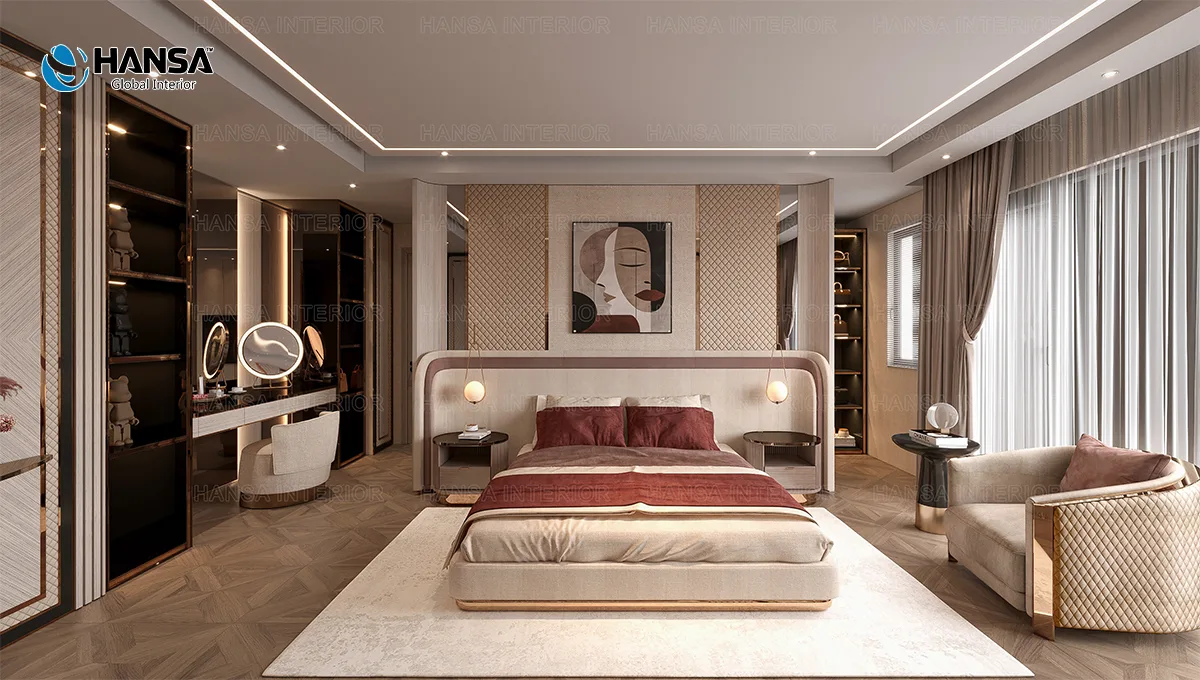
It is precisely thanks to these meticulous and standardized procedures that each luxury living room or bedroom furniture product truly becomes a vibrant work of art, worthy of the homeowner’s high-class living space.
HANSA INTERIOR COMPANY
- Southern Office: 55 Street No. 39, Van Phuc Urban Area, Hiep Binh Ward, Ho Chi Minh City
- Northern Office: 37 Alley 98, Dam Quang Trung Street, Long Bien Ward, Long Bien District, Hanoi.
- Factory: 263 Nguyen Thi Minh Khai Street, Di An Ward, Ho Chi Minh City.
- Mobile: 0912.471.925 – 090.139.8689
- Email: hansaglobalvn@gmail.com
- Website: www.hansaglobal.vn
You may be interested in
Explore the Technologies and Techniques in Luxury Wooden Interiors
Why do the elite favor the Contemporary style over the Neoclassical style?
Comparing natural wood and engineered wood in contemporary style